Here's what we tell every homeowner who calls us with that question: the repair-or-replace decision isn't just about your system's age or its repair history. Where your electric furnace sits in your home changes the entire equation. Placement affects airflow efficiency, component accessibility, and what any repair or replacement job actually costs to complete — factors that rarely make it into the quote you're handed.
This page gives you the honest, experience-backed framework we use in the field every day — so you can walk into that conversation with your HVAC technician knowing exactly what to ask, what to watch for, and what the right answer looks like for your home when replacing the AC unit.
TL;DR Quick Answers
replacing home ac unit
Replacing a home AC unit is the right call when your system is 10 to 15 years old, has needed repeated repairs, or is driving up energy bills without explanation. Here is what to know before making the decision:
A system over 10 years old showing declining performance is typically more expensive to keep than to replace
Use the 5,000 rule: multiply system age by repair cost — if the result exceeds $5,000, replacement wins
Furnace placement affects labor costs for both repair and replacement — always ask your technician how your specific installation impacts the quote
Improper installation on a new system can reduce efficiency by up to 30% — equipment quality means nothing without proper placement and airflow
Duct condition must be evaluated before replacing any system — a new unit installed on a leaking duct network inherits the same problems
Qualifying replacement systems may be eligible for a federal tax credit of up to 30% of equipment costs under the Energy Efficient Home Improvement Credit
The repair-or-replace decision is not just about the equipment. It is about the full system — placement, ducts, airflow, and efficiency trajectory — evaluated together before anything is signed.
Top Takeaways
Furnace placement directly affects what any repair or replacement job costs. Attic installations cost more to service than basement units. The same failed component carries a different price tag depending on where your furnace sits.
Age and repair history are only part of the equation. Here's a quick guide:
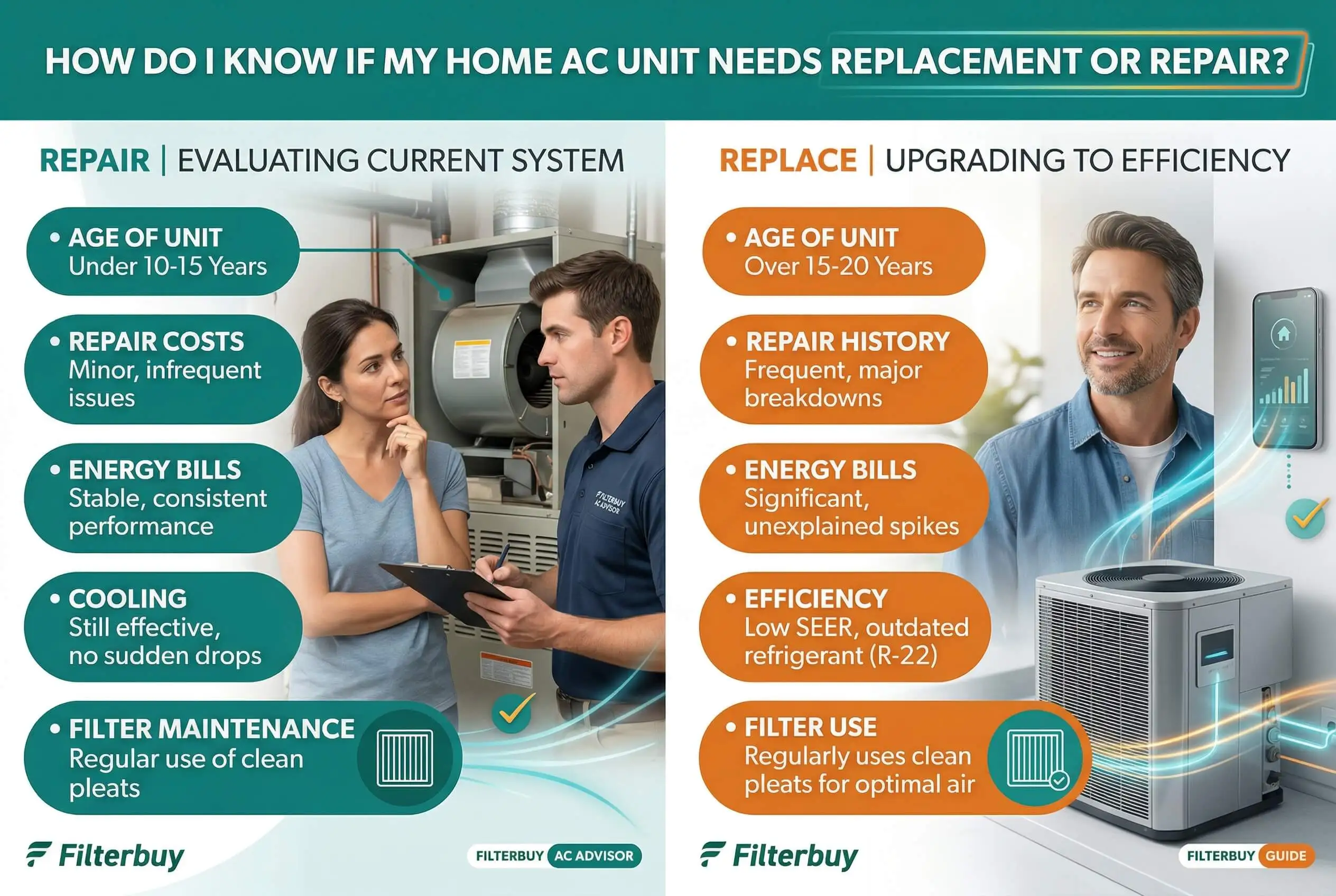
Under 10 years old with an isolated failure — repair is likely the right call
Over 10 to 15 years old with recurring repairs and rising energy bills — replacement is likely the smarter investment
A new system installed incorrectly performs like an old one. Improper installation can reduce efficiency by up to 30%. Always verify these three things before your technician leaves:
Correct refrigerant charge
Proper airflow
Placement and accessibility accounted for in the installation
Duct condition determines how well any system performs. In a typical home, 20 to 30 percent of conditioned air never reaches living spaces. A new system on a compromised duct network inherits the same problems as the one it replaced.
A full system evaluation is the only basis for a confident decision. A trustworthy technician inspects all of the following before making a recommendation:
Equipment age and repair history
Furnace placement and accessibility
Duct condition and airflow integrity
Home's specific cooling load
What Is Electric Furnace Placement and Why Does It Matter?
An electric furnace is the indoor component of your home's heating and cooling system. It houses the blower motor that circulates conditioned air throughout your home and works alongside your outdoor AC unit to deliver both heat and cooling. Where that furnace sits — in a closet, attic, basement, crawl space, or utility room — is what HVAC technicians refer to as placement.
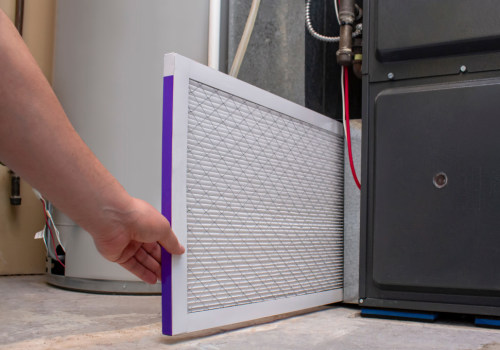
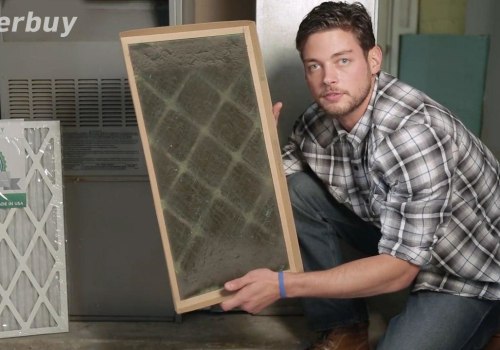
Placement matters because it directly affects how accessible your system is, how efficiently it moves air, and how much labor is involved in any repair or replacement job — especially when easy access to the air conditioner filter makes inspections, replacements, and airflow upkeep simpler and more effective. A furnace tucked into a tight attic space costs more to service than one sitting in an open basement. That labor difference can shift a repair from affordable to impractical — and a replacement from expensive to the smarter long-term investment.
How to Tell If Your AC Unit Needs Repair or Replacement
Most homeowners assume age is the deciding factor. Age matters, but it's one piece of a larger picture. In our experience, the clearest signals come from a combination of performance, repair history, and cost patterns.
Signs your system likely needs repair:
The issue is isolated — one component has failed, and the rest of the system is functioning normally
Your system is under 10 years old with no significant repair history
The repair cost is less than 50% of what a new system would cost
Your energy bills have remained relatively stable over the past year
Signs your system likely needs replacement:
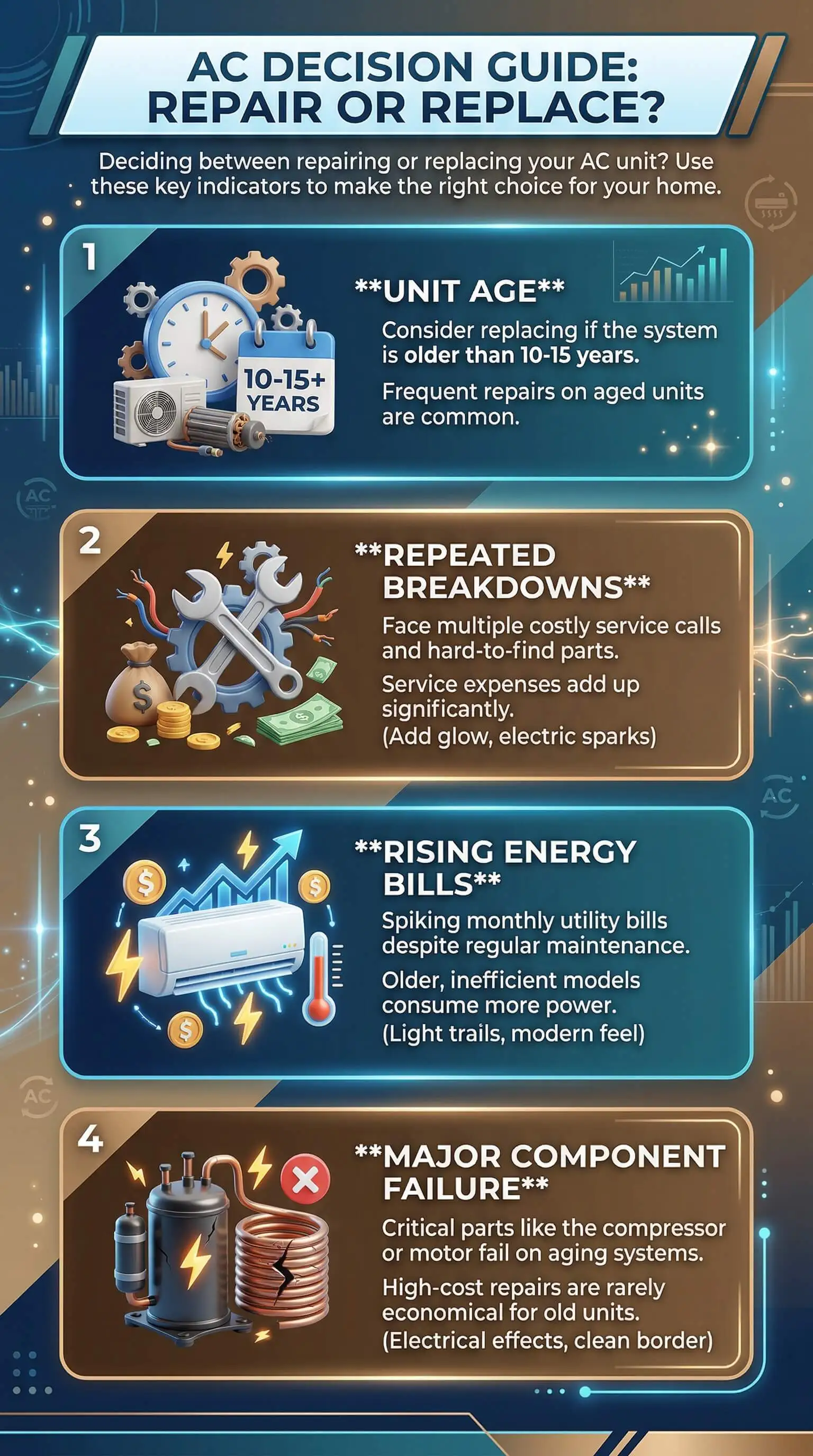
Your AC unit is 10 to 15 years old or older
You've had two or more repairs in the past two years
Repair costs exceed half the price of a new system
Your home has persistent hot and cold spots that repairs haven't resolved
Your energy bills have increased steadily without a clear explanation
How Electric Furnace Placement Affects the Repair-or-Replace Decision
This is where most repair quotes leave homeowners with incomplete information. A technician may give you a part cost without factoring in the full labor picture — and placement is what drives labor costs up.
An attic-mounted furnace with limited access, for example, can add hours to a job that would take half the time in a basement installation. If you're already looking at a costly repair on an older system, that additional labor can tip the scale decisively toward replacement. On the other hand, a well-placed, accessible furnace on a system that's otherwise healthy makes repair the clear choice.
When evaluating any quote, ask your technician directly: how does where my furnace is located affect what this job will cost, and would that same placement affect the cost of a full replacement?
The Real Cost Comparison: Repair vs. Replace
A useful rule of thumb in the industry is the 5,000 rule: multiply your system's age by the estimated repair cost. If that number exceeds $5,000, replacement is generally the better investment. If it falls below $5,000, repair often makes more financial sense.
That calculation should also account for efficiency. Older systems typically operate at significantly lower efficiency ratings than current models. A new high-efficiency system can reduce energy costs enough to offset a portion of the replacement investment over time, and top air filters can further support that performance — a factor your repair quote will never reflect.
When to Call an HVAC Professional
If your system is showing any of the signs above, a second opinion is always worth getting before committing to either path. A qualified technician should inspect the full system — not just the component that failed — and account for your specific installation before making a recommendation.
The placement of your electric furnace, the condition of your ductwork, and your home's cooling load all factor into what the right answer looks like for your situation. A trustworthy HVAC professional will walk you through all of it before asking you to sign anything.
"Most homeowners never think to ask how their furnace placement affects what a repair is actually going to cost them — and that missing piece of information can be the difference between a $600 fix and a $2,500 job that still doesn't solve the underlying problem. After working on HVAC systems in hundreds of homes, I can tell you that two systems with the exact same failed component can carry completely different price tags based entirely on where that furnace sits. An attic installation with a narrow access hatch is a fundamentally different job than a basement unit with room to work. Before you approve any repair quote, make sure your technician has walked your installation — not just diagnosed the part."
Essential Resources
We've serviced enough HVAC systems to know that replacing an AC unit raises a lot of questions — and the wrong answers can cost you thousands. These are the resources we point homeowners to when they want straight, reliable information before making that call.
1. Not Sure If It's Time? Start With This Official Replacement Checklist
ENERGY STAR's replacement guide is the clearest tool available for homeowners who aren't sure whether their system is failing or just struggling. It covers age thresholds, repair frequency, and the humidity and energy bill patterns we see most often in homes that are overdue for a new system.
https://www.energystar.gov/saveathome/heating-cooling/replace
2. Before You Buy Anything, Understand How Central AC Systems Actually Work
The Department of Energy's central air guide explains sizing, SEER ratings, and duct requirements in plain language. Knowing this before you talk to a contractor means you'll ask better questions — and spot when a quote doesn't add up.
https://www.energy.gov/energysaver/central-air-conditioning
3. A Bad Installation Can Undo Everything — Here's What to Watch For
This is one homeowners rarely hear until it's too late: improper installation can cut a new system's efficiency by up to 30%. ENERGY STAR's efficiency guide walks you through what proper installation looks like, so you know what to verify before your technician leaves.
https://www.energystar.gov/saveathome/heating-cooling
4. The Right System Can Put Money Back in Your Pocket — Here's How
If you're replacing your AC, choosing an eligible system can qualify you for a federal tax credit worth up to 30% of the equipment cost. This ENERGY STAR page breaks down the SEER2 efficiency thresholds required — updated for 2025 — so you know exactly what to look for when comparing systems.
https://www.energystar.gov/about/federal-tax-credits/central-air-conditioners
5. Don't Leave the Tax Credit on the Table — Know How to Claim It
The IRS's 25C credit page is the resource to bookmark before you sign anything. It covers qualifying expenses, annual limits up to $3,200, and how to file with Form 5695. Missing a documentation step is one of the most common reasons homeowners lose the credit entirely.
https://www.irs.gov/credits-deductions/energy-efficient-home-improvement-credit
6. If Your System Uses R-22 or R-410A, Read This Before You Repair It
This is a question we get often: is it still worth repairing a system that runs on a phased-out refrigerant? The EPA's homeowner FAQ answers it directly — including what the R-22 and R-410A phaseouts mean for your service options and why the answer affects your repair-or-replace decision more than most technicians will tell you upfront.
https://www.epa.gov/ods-phaseout/homeowners-and-consumers-frequently-asked-questions
7. Use Government Data to Compare Replacement Systems Side by Side
When you're looking at competing quotes, this Department of Energy purchasing guide gives you an objective baseline. It includes lifetime energy cost comparisons and ENERGY STAR certification criteria — the same benchmarks we use when recommending systems to the homeowners we work with.
https://www.energy.gov/cmei/femp/purchasing-energy-efficient-residential-central-air-conditioners
Before replacing your AC unit, use these trusted resources to understand system performance, tax credit eligibility, refrigerant changes, and how the ideal temperature for air conditioning systems affects comfort, efficiency, and long-term cost savings.
Supporting Statistics
Most homeowners come to us focused on the repair quote in their hand. What they're not thinking about is what the system is already costing them every month before anything breaks — and how pleated air filters can play a major role in that cost. These numbers put the full picture in focus.
Nearly half of every dollar you spend on home energy goes to heating and cooling.
ENERGY STAR data shows the average U.S. household spends nearly $1,900 a year on home energy. Close to half goes to heating and cooling alone. After servicing systems across thousands of homes, here's what that means in practice:
An aging system doesn't just break down eventually
It overcharges you every month leading up to that moment
Improper sizing and placement-related airflow restrictions make it worse
A struggling system is an expensive system — long before it fails.
Source: ENERGY STAR — Heat and Cool Efficiently https://www.energystar.gov/saveathome/heating-cooling
Improper installation can erase up to 30% of a new system's efficiency before it runs a single full season.
ENERGY STAR confirms poor installation can reduce a new system's efficiency by as much as 30%. We see the result of this regularly. Homeowners call us about a system replaced just a few years prior — experiencing the same comfort problems they thought they'd solved. In nearly every case, the equipment wasn't the issue. These three factors were:
Placement
Refrigerant charge
Airflow
A new system installed without attention to those fundamentals starts underperforming on day one.
Source: ENERGY STAR — Heat and Cool Efficiently https://www.energystar.gov/saveathome/heating-cooling
In a typical home, 20 to 30 percent of conditioned air never reaches the rooms it's meant to cool.
ENERGY STAR's duct sealing research confirms it. Leaks, holes, and poorly connected ducts are the cause. We see the consequences every week:
Homeowners convinced their AC unit is failing
The real problem is a duct system that's been losing efficiency for years
A new system installed on a compromised duct network doesn't fix the problem — it transfers it
It's one of the reasons we always inspect ductwork before recommending replacement.
Source: ENERGY STAR — Duct Sealing https://www.energystar.gov/saveathome/heating-cooling/duct-sealing
Air conditioning accounts for 19% of all electricity consumed in U.S. homes — and an aging system drives that number higher every year it stays in service.
The U.S. Energy Information Administration's 2020 Residential Energy Consumption Survey puts it at 254 billion kilowatt-hours annually. What that national figure doesn't show is how that number grows in homes with older, degraded systems. In our experience, homeowners replacing a system that's 12 to 15 years old typically see:
Measurable drops in monthly energy costs within the first billing cycle
Improved comfort in rooms that were previously hard to cool
Fewer service calls in the first years following replacement
The efficiency gap between an aging unit and a properly installed modern system isn't theoretical. It shows up in the numbers.
Source: U.S. Energy Information Administration — Residential Energy Consumption Survey https://www.eia.gov/tools/faqs/faq.php?id=1174&t=1
Final Thoughts
Most repair-or-replace decisions don't fail because homeowners chose the wrong answer. They fail because homeowners didn't have the full picture when they made the call.
After working on HVAC systems across thousands of homes, our honest perspective is this: the equipment is rarely the whole story, especially when MERV 11 pleated air filters are part of the system’s overall performance.
Here's what we've learned that most homeowners never hear:
The same failed component can carry two completely different price tags depending on where your furnace sits in the home
A system running at reduced efficiency because of a poor installation costs more every month than the repair quote that preceded it
Ductwork condition determines how well any system performs — new or old
Comfort problems homeowners attribute to aging equipment are frequently placement and airflow problems that replacement alone won't solve
The repair-or-replace question is real. But the more important question is whether anyone has looked at the full system — not just the part that broke.
A trustworthy HVAC evaluation covers all of the following before a recommendation is made:
Equipment age and repair history
Furnace placement and accessibility
Duct condition and airflow integrity
Your home's specific cooling load
Anything short of that isn't a diagnosis. It's a guess — and an expensive one.
Our opinion: if you haven't had a full system evaluation from a qualified technician who has physically walked your installation, you don't yet have the information you need to make this decision with confidence. Get that evaluation before you sign anything.
FAQ on Replacing Home AC Unit
Q: How do I know if my home AC unit needs to be replaced or just repaired?
A: Age and repair cost alone rarely tell the full story. After evaluating systems across thousands of homes, the clearest signal is always a pattern. Watch for these signs:
Recurring repairs within the same system
Climbing energy bills without a clear explanation
Rooms that never reach the right temperature
Use the 5,000 rule as a starting point:
Multiply your system's age by the estimated repair cost
If the result exceeds $5,000, replacement typically wins
If it falls below $5,000, repair often makes more financial sense
The number that matters most is what your system is already costing you every month in wasted energy — before anything breaks.
Q: How does electric furnace placement affect the cost of replacing my AC unit?
A: This is the question most homeowners don't know to ask — and it's often the one that changes everything. Here's what placement means in practice:
A furnace in a tight attic with limited access can turn a straightforward repair into a half-day labor job
That same repair in an open basement takes half the time at half the cost
Placement affects both repair and full replacement costs
Before approving any quote, ask your technician directly:
How does my furnace location affect what this job costs?
Would that same placement affect the cost of a full replacement?
If they can't answer both questions specifically, get a second opinion.
Q: What is the average lifespan of a central AC unit?
A: Most central AC units last 10 to 15 years with regular maintenance. Some reach 20 years with consistent care. But lifespan isn't the number to focus on. What matters more is efficiency trajectory:
A system 12 to 15 years old running below its original efficiency rating costs money every month — even when it hasn't failed
A system doesn't have to be broken to be worth replacing
It just has to be costing more than a better option would
Regular maintenance that extends lifespan includes:
Consistent filter changes
Annual tune-ups
Prompt attention to minor repairs
Q: Can I qualify for a federal tax credit when replacing my home AC unit?
A: In many cases, yes. It's one of the first things we walk homeowners through when a replacement conversation starts. Here's what to know:
Qualifying systems can earn up to 30% back on equipment costs
The annual credit limit for qualifying HVAC equipment is $1,200
As of January 1, 2025, split systems must meet a SEER2 rating of 17.0 or higher to be eligible
Don't miss these critical steps:
Confirm eligibility before purchasing — not after
Keep every receipt and installation record
File using IRS Form 5695
Q: How does duct condition affect my decision to repair or replace my AC unit?
A: More than most people expect. It's the factor we find most often at the root of comfort complaints that get misattributed to the AC unit itself. Here's what the data shows:
In a typical home, 20 to 30 percent of conditioned air never reaches its destination
Duct leaks and poor connections are the cause
A brand new system underperforms when installed on an uninspected duct network
Before committing to repair or replacement, a full evaluation should cover:
Duct leakage and connection integrity
Airflow distribution across all rooms
Duct placement in unconditioned spaces such as attics and crawl spaces
Replacing equipment without inspecting the ducts doesn't solve the problem. It just gives it a new starting point.
Not Sure Whether to Repair or Replace Your Home AC Unit? Let Filterbuy HVAC Solutions Take a Look.
If your system is showing signs of age, rising energy costs, or placement-related performance issues, the right answer starts with a full system evaluation — not a guess. Contact Filterbuy HVAC Solutions today and let a qualified local technician walk your installation, assess your options, and give you the honest recommendation your home deserves.