Don't let pollen win inside your own home. Most homeowners shut their windows and call it done — but after manufacturing air filters for over a decade and helping more than two million households breathe easier, we know the real threat is already inside, recirculating through your ducts every time your HVAC system runs.
What we've learned is this: understanding when is allergy season is the first step to protecting your home and your family. Once you know when pollen levels are likely to rise, you can treat indoor pollen control as a filtration problem first. The right MERV rating stops allergens before they reach your living spaces. The right habits keep them from sneaking back in. This page gives you both — so allergy season stops being something your family just survives.
TL;DR Quick Answers
When Is Allergy Season?
Allergy season in the U.S. runs longer than most households plan for — up to nine months in many regions. Here is when each pollen window peaks:
Tree pollen: February through May — starts as early as January in the Southeast
Grass pollen: May through July — overlaps with late tree pollen for a high-intensity window in May
Ragweed and weed pollen: August through October — now extends weeks later than it did a generation ago
Key facts to know:
Allergy season has lengthened by 20 days since 1990
Pollen concentrations have increased 21% over the same period
60 million Americans experience allergic rhinitis symptoms annually
Indoor pollen levels rise with outdoor counts — your HVAC system recirculates every grain that makes it inside
The bottom line: allergy season is no longer a short spring event. It is a year-round air quality challenge that starts earlier, ends later, and hits harder than the calendar most households are still using. Upgrading to a MERV 11 or MERV 13 filter and adjusting your replacement schedule for peak pollen months are the two most impactful steps you can take to protect your home from the inside out.
Top Takeaways
Upgrade your filter first. A MERV 8 was never designed to stop fine pollen. Moving to MERV 11 or MERV 13 is the single highest-impact change an allergy-prone household can make.
Allergy season is longer than it used to be. Pollen seasons are 20 days longer and 21% more concentrated than in 1990. Strategies built for a previous generation's allergy season are no longer enough.
Your standard change schedule is not built for peak pollen months. A filter that lasts 90 days in winter can be overwhelmed in 30 days during spring and fall. Check visually every 30 days — replace before the calendar tells you to.
Pollen does not stay where it lands. It recirculates every time your HVAC runs, someone walks across the floor, or a ceiling fan turns. Filtration and cleaning habits work together — one without the other leaves your family exposed.
Indoor pollen is a solvable problem. The right MERV rating, a seasonally adjusted change schedule, sealed entry points, and continuous fan circulation give your household a measurable, lasting advantage every allergy season.
Upgrade Your Air Filter — It's the Highest-Impact Step You Can Take
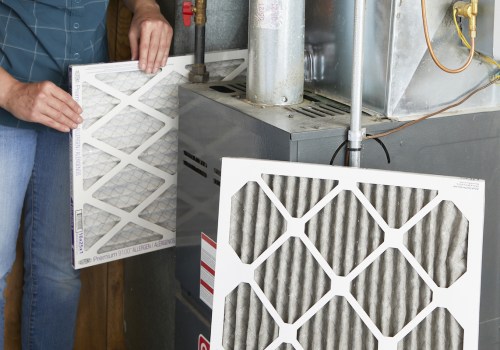
Your HVAC filter is the first and most important line of defense against indoor pollen. After manufacturing filters for over a decade and working with millions of allergy-prone households, we've seen one pattern more than any other: families still running a MERV 8 filter wonder why their symptoms don't improve.
Here's what that means in practice:
MERV 8 filters capture larger particles like dust and lint but allow fine pollen and smaller allergens to pass through freely.
MERV 11 filters trap a broader range of pollen particles and are a meaningful upgrade for households with mild to moderate allergies.
MERV 13 filters are the optimal choice for allergy sufferers — capturing pollen, mold spores, pet dander, and fine particulate matter that lower-rated filters miss entirely.
One important caveat from our manufacturing experience: always verify your HVAC system's compatibility before jumping to a higher MERV rating. Filters that are too restrictive for your system can reduce airflow and strain your equipment.
Change Your Filter More Frequently During Peak Pollen Season
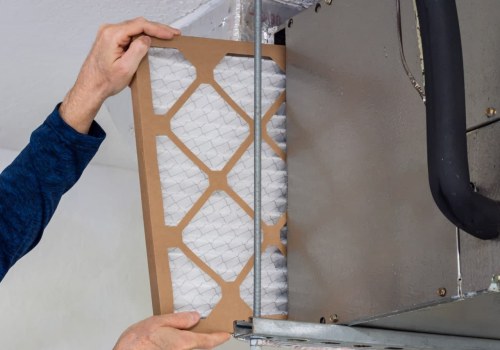
Filter change intervals aren't one-size-fits-all — and allergy season is exactly when standard schedules fall short. During high-pollen months, filters load up faster. A filter that performs well for 90 days in winter may be overwhelmed within 30 to 45 days in spring.
What we recommend based on what we've observed across millions of customers:
Check your filter visually every 30 days during allergy season.
Replace it as soon as the media appears visibly gray or clogged — don't wait for the calendar.
Households with pets, multiple allergy sufferers, or homes in high-pollen regions should default to 30-day replacements during peak season.
Control Entry Points Where Pollen Sneaks In
Even the best filter can't compensate for pollen pouring in through unsealed gaps. In our experience, the entry points most homeowners overlook are the ones that undercut everything else they're doing.
Focus on these areas:
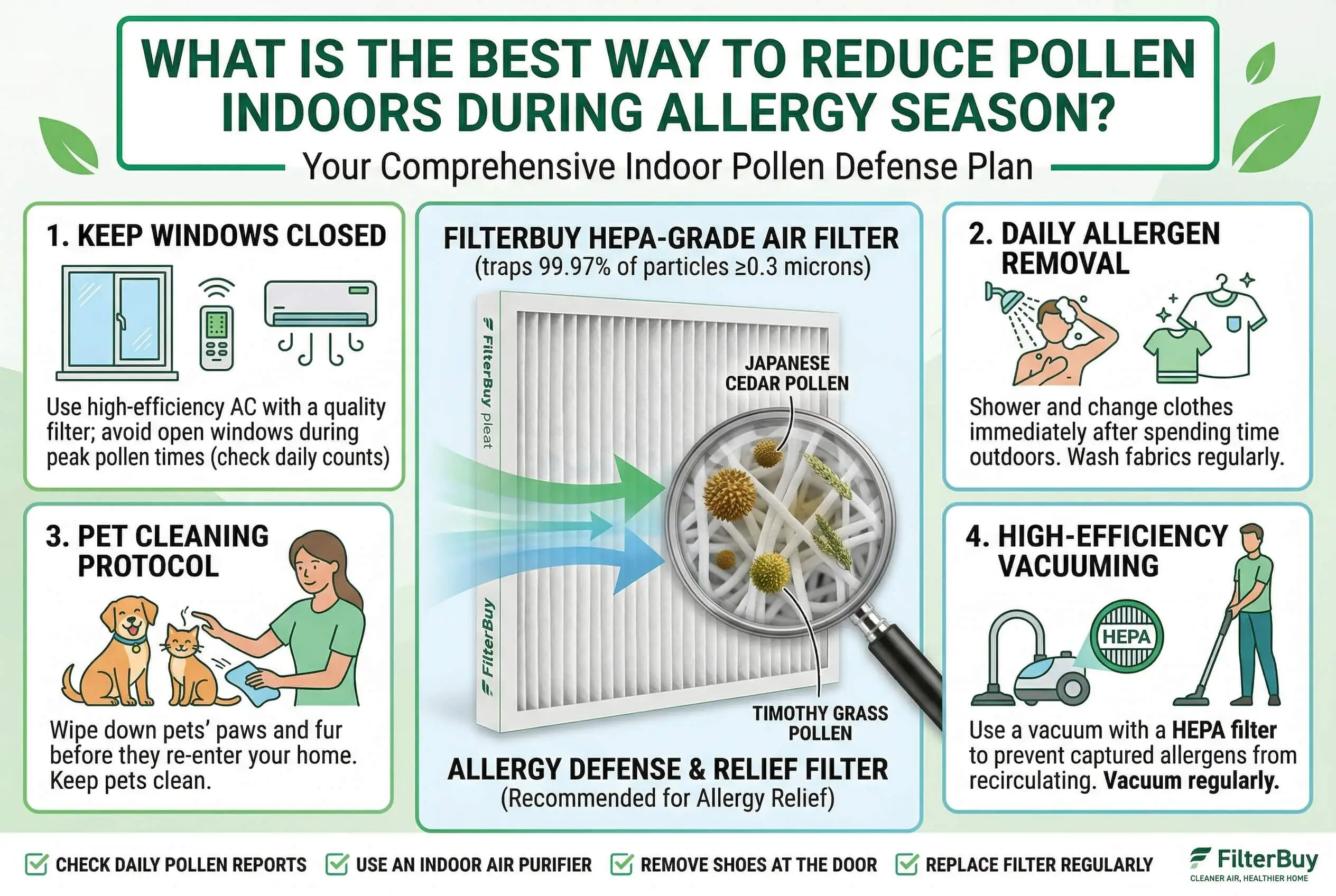
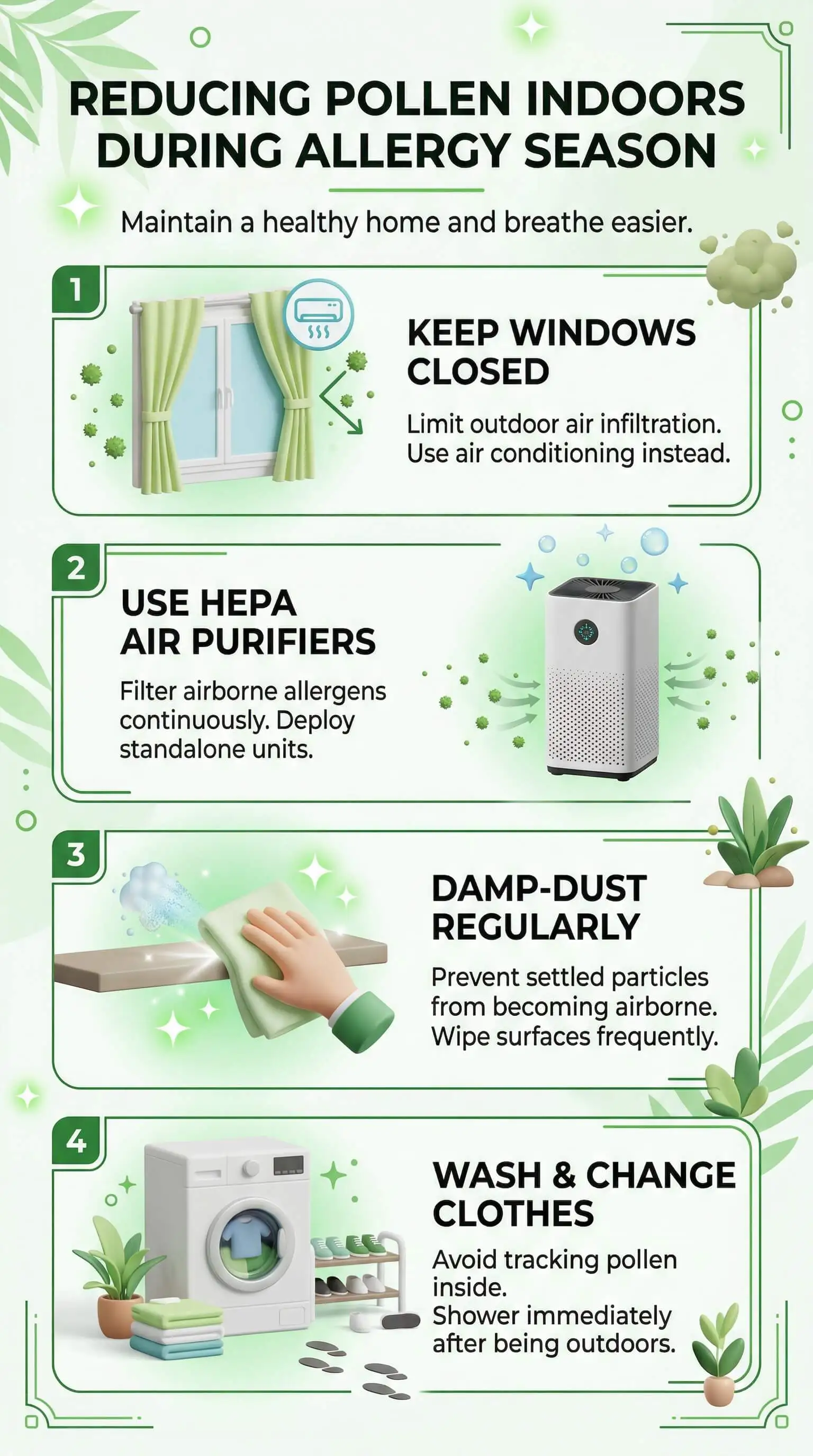
Doors and windows: Keep them closed during peak pollen hours, typically morning through early afternoon. Use weatherstripping to seal gaps around door frames.
Clothing and shoes: Pollen hitches a ride indoors on fabric. Removing shoes at the door and changing clothes after time outdoors makes a measurable difference.
Pets: Animals that go outdoors carry pollen directly onto furniture and bedding. Wiping pets down before they come back inside significantly reduces indoor pollen load.
Run Your HVAC System Strategically
Your HVAC system does more than heat and cool — it filters your air every time it runs. One of the simplest habits we share with homeowners is this: during high-pollen days, keep your system running in fan mode. This continuously cycles air through your filter rather than letting pollen settle on surfaces between cooling cycles.
A few habits that compound your results:
Set your thermostat fan to "On" rather than "Auto" during allergy season to maintain continuous filtration.
Avoid opening windows when outdoor pollen counts are elevated — check your local AQI before letting in outside air.
Schedule HVAC maintenance before peak season so your system is clean, sealed, and operating efficiently when pollen counts peak.
Don't Overlook Surface Pollen — It Recirculates
Pollen that settles on floors, furniture, and bedding doesn't stay there. Normal foot traffic, sitting down, or even turning on a ceiling fan kicks it back into the air where you breathe it in. This is why filtration alone isn't a complete solution.
Practical steps to reduce recirculation:
Vacuum with a HEPA-equipped vacuum cleaner at least twice a week during allergy season.
Wash bedding in hot water weekly — bedding is one of the highest-concentration pollen surfaces in a home.
Use a damp microfiber cloth for hard surfaces rather than dry dusting, which sends particles airborne.
Consider Air Purifiers for High-Traffic Rooms
For households with severe allergy sufferers, a portable air purifier in key rooms adds a second layer of filtration that works independently of your HVAC system. This is especially useful in bedrooms, where people spend six to eight hours breathing the same air.
Look for units with true HEPA filtration, which captures 99.97% of particles at 0.3 microns — well within the range where pollen and fine allergens fall. Position purifiers away from walls and in the center of the room for maximum air circulation coverage.
"After manufacturing air filters for over a decade and serving more than two million households, one thing stands out during allergy season: most families are fighting pollen with the wrong tool. They clean surfaces, they keep windows shut — and yet their symptoms persist. What they don't realize is that their HVAC system is redistributing the problem every time it cycles. The filter is either stopping pollen before it reaches your living spaces or it isn't. A MERV 13 filter paired with more frequent changes during peak season isn't a luxury for allergy sufferers — in our experience, it's the single most impactful change a household can make. Everything else compounds from there."
Essential Resources
7 Resources Every Allergy Sufferer Needs Before Pollen Season Peaks
Allergy season doesn't announce itself — it builds quietly while your HVAC system recirculates every grain of pollen that makes it indoors. After manufacturing air filters for over a decade and helping more than two million households breathe easier, we know that preparation is everything. These seven authoritative resources give you the full picture: when your local season starts, what's driving it, and how to stop it at the source.
CDC: Why Allergy Season Is Getting Longer — and What That Means for Your Home The CDC confirms what we've observed across millions of filter customers: allergy season is no longer predictable. Rising temperatures and elevated CO2 have extended pollen seasons and intensified concentrations — affecting up to 60 million Americans annually. Understanding the trend is the first step toward protecting your family indoors. https://www.cdc.gov/climate-health/php/effects/allergens-and-pollen.html
AAFA: The U.S. Pollen Calendar That Tells You Exactly When Your Season Starts The Asthma and Allergy Foundation of America maps tree, grass, and weed pollen windows across the country — from February tree pollen through October ragweed. This is the resource we point to when homeowners ask why their symptoms haven't stopped: allergy season in most U.S. regions runs 6 to 9 months, not just spring. https://aafa.org/allergies/types-of-allergies/pollen-allergy/
HHS: Federal Pollen Data Showing How Much Earlier Spring — and Symptoms — Now Arrive U.S. Department of Health and Human Services data visualizes how pollen season is arriving weeks ahead of historical norms across the country. One physician cited by HHS now recommends patients start allergy medication on Valentine's Day rather than St. Patrick's Day — that's how dramatically the window has shifted. Know your region's timing before you're caught off guard. https://www.hhs.gov/climate-change-health-equity-environmental-justice/climate-change-health-equity/climate-health-outlook/pollen/index.html
NEEF: A Practical Breakdown of Allergy Season Timing, Triggers, and Indoor Protection Steps The National Environmental Education Foundation translates pollen science into actionable guidance — covering when each allergen peaks, why HVAC filtration matters, and how to use real-time monitoring tools to time your defenses. This is the resource that connects the outdoor calendar to what you do inside your home. https://www.neefusa.org/story/health-and-environment/when-allergy-season
EPA: How Pollen Gets Inside Your Home — and How to Stop It Most homeowners focus on outdoor exposure. The EPA makes the invisible visible: pollen enters through doors, windows, clothing, and pets — and your HVAC system redistributes it continuously once it's in. This resource explains the full pathway and provides guidance on using filtration and AirNow monitoring to keep your indoor environment protected. https://www.epa.gov/indoor-air-quality-iaq/biological-pollutants-impact-indoor-air-quality
NIH: The Scientific Case for Upgrading Your HVAC Filter Before Allergy Season This National Institutes of Health review documents what we've built our filters around: standard HVAC filters were designed to protect equipment, not your family. They fall short on the fine particles that cause allergic reactions. The NIH makes the evidence-based case for upgrading to higher-efficiency filtration — the single most impactful step you can take inside your home. https://www.ncbi.nlm.nih.gov/books/NBK236018/
National Allergy Bureau: 14 Years of Pollen Season Data Mapped by Region and Plant Type Drawn from 31 monitoring stations across the U.S. and Canada, this research gives allergy sufferers the most precise picture available of when their local season actually begins — broken down by pollen type, latitude, and duration. If you want to stop guessing and start planning, this is your benchmark. https://pubmed.ncbi.nlm.nih.gov/31929678/
Supporting Statistics
Numbers tell part of the story. What we've learned manufacturing filters for over a decade and serving more than two million households tells the rest. These statistics describe exactly what we see playing out inside the homes we help protect every allergy season.
60 million Americans experience allergic rhinitis symptoms every year.
Nearly one in five people you know is losing sleep, missing work, or medicating through symptoms made worse by the air inside their own home. What the CDC data doesn't show is what we see firsthand:
Households running basic filters wondering why high-pollen days still devastate their family's comfort
The answer almost always traces back to filtration never designed with allergy season in mind
Source: CDC — Allergens and Pollen https://www.cdc.gov/climate-health/php/effects/allergens-and-pollen.html
Pollen seasons have lengthened by 20 days and concentrations have increased 21% since 1990.
An NIH-indexed study of 60 North American pollen stations found human-caused climate change responsible for roughly half of that trend. What this means for your home:
The 90-day filter replacement window that once made sense no longer accounts for a season that starts earlier and ends later
The allergy calendar your parents used no longer applies to the season your family is facing today
Source: NIH / PubMed — Anthropogenic Climate Change Is Worsening North American Pollen Seasons https://pmc.ncbi.nlm.nih.gov/articles/PMC7896283/
Ragweed season has grown by up to 21 days in Fargo, ND, and 18 days in Minneapolis, MN, since 1995.
U.S. EPA data confirms what Midwest and Northeast homeowners tell us every fall — their symptoms feel worse than they used to, because they are. Here's where households consistently get caught off guard:
They manage spring pollen well, then leave an outdated filter in place through a fall season that has quietly expanded
Delayed first frosts are pushing ragweed deeper into October across northern states
Knowing your region's extended window is the difference between getting ahead of the season and spending October reacting to it
Source: U.S. EPA — Climate Change Indicators: Ragweed Pollen Season https://19january2021snapshot.epa.gov/climate-indicators/climate-change-indicators-ragweed-pollen-season_.html
Hay fever drives more than 13 million physician visits every year in the United States.
That figure covers only those who sought medical care — not the far larger number managing symptoms at home. What we've observed across millions of filter customers:
Households that upgrade to MERV 11 or MERV 13 and adjust their change schedule for peak season consistently report fewer symptom days
Catching pollen at the filter before it reaches your airways is always a better outcome than treating symptoms after the fact
Source: U.S. EPA — Climate Change Indicators: Ragweed Pollen Season https://19january2021snapshot.epa.gov/climate-indicators/climate-change-indicators-ragweed-pollen-season_.html
Final Thoughts
The pollen season has changed. The data confirms it, the science explains it, and after over a decade of manufacturing filters and serving more than two million households, we see it firsthand — in the questions homeowners ask, the symptoms that linger longer than they used to, and the filters that arrive visibly overwhelmed weeks ahead of schedule.
Our honest opinion: most households are managing allergy season with strategies built for a season that no longer exists.
Here is what has changed:
Pollen seasons are now 20 days longer than they were in 1990
Ragweed runs well into October across northern U.S. states
Airborne pollen concentrations are 21% higher than a generation ago
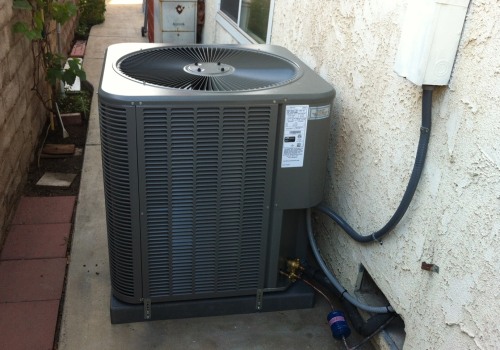
The season your habits were built around is not the season your family is living through today — especially when air conditioning systems now play such a central role in managing indoor comfort and air quality.
What consistently separates households that breathe easier from those that don't comes down to three things:
Filtration rating matters more than most homeowners realize. A MERV 8 filter was never designed to stop fine pollen. Upgrading to MERV 11 or MERV 13 is the single highest-impact change an allergy-prone household can make.
Change schedules must flex with the season. A filter that performs adequately for 90 days in winter can be overwhelmed in 30 days during peak pollen months. The interval on the box was not written with your local allergy season in mind.
Surface pollen recirculates. Filtration alone is not enough. Pollen that settles on floors, bedding, and furniture re-enters the air with every step and every ceiling fan gust. Filtration and cleaning habits work together — neither fully replaces the other.
Indoor air quality during allergy season is a solvable problem that most families treat as an unavoidable one. The families who understand what is moving through their air — and why their HVAC system is either their greatest ally or their biggest liability during pollen season — are the ones who stop reacting and start protecting.
You are the hero of your household when it comes to the air your family breathes. The steps are clear, the tools exist, and the season is not waiting.
FAQ on When Is Allergy Season
Q: When does allergy season start in the United States? A: It depends on your region — and it starts earlier than most households expect.
Southeast and South Central states: tree pollen arrives as early as January
Northeast and Midwest: March or April is the typical trigger point
Some northern regions are now seeing start dates arrive two to three weeks ahead of historical norms
What we've seen serving households across the country: families are consistently caught off guard because their mental calendar for allergy season is running behind the actual one.
Q: When is allergy season at its worst? A: The most punishing window is the May overlap between late tree pollen and early grass pollen — two major allergen categories airborne simultaneously. Fall is equally important to plan for:
Ragweed season has grown by as much as 21 days in northern U.S. cities since 1995
Fall symptoms now extend well into October across the Midwest and Northeast
Families who only brace for spring and coast through fall are the ones most caught off guard in October
Q: How long does allergy season last? A: Far longer than most households plan for.
Meaningful pollen exposure now runs January through October for many U.S. households — up to nine months
NIH-indexed research from 60 North American stations confirms seasons have lengthened by 20 days
Pollen concentrations have increased 21% since 1990
The most common mistake we see: treating allergy season as a short spring event and managing filter schedules accordingly. A 90-day filter in a year-round pollen environment is not a strategy — it is a gap in your home's defenses.
Q: Does allergy season affect indoor air quality? A: Significantly — and it is the problem most households underestimate. Here is what is actually happening inside your home:
Pollen enters through doors, windows, clothing, shoes, and pets
Your HVAC system redistributes it every time it cycles
Closed windows reduce infiltration but do not eliminate it
What we've seen firsthand: households still suffering through peak season despite managing outdoor exposure well are almost always running a filter never rated to stop fine pollen. Two changes that reliably shift the outcome:
Upgrade to MERV 11 or MERV 13
Switch your HVAC fan from "Auto" to "On" for continuous filtration
Q: How should I adjust my home during allergy season? A: After serving more than two million households, these are the five adjustments that consistently make the most measurable difference:
Upgrade your filter. Move to MERV 11 or MERV 13 — your current filter may be protecting your equipment, not your family
Check your filter every 30 days during peak season — not every 90 days
Switch your HVAC fan from "Auto" to "On" for continuous filtration between heating and cooling cycles
Remove shoes at the door and change clothes after time outdoors — pollen travels on fabric more efficiently than most people expect
Vacuum with a HEPA-equipped vacuum twice a week and wash bedding weekly — settled pollen recirculates, and these two surfaces hold the highest indoor concentrations
Stop Pollen Before It Reaches Your Family This Allergy Season
Reducing pollen indoors starts with the right filter — and after manufacturing filters for over a decade and serving more than two million households, we know exactly which one your home needs. Shop Filterbuy's MERV 11 and MERV 13 filters today and take the most impactful step toward cleaner, healthier air before peak pollen season arrives.