The two things most likely to hurt somebody in a Rochester home this winter will never show up on an air quality monitor. Radon and carbon monoxide are both invisible, both odorless, and both sit completely outside what a $180 consumer device measures. Your monitor graphs particulates all season and misses them entirely.
So here’s the sequence I’d follow. Radon, then carbon monoxide, then moisture, then particles. The order protects your family more than the equipment ever will.
That sequence isn’t arbitrary. Rochester sits on the south shore of Lake Ontario, in a housing stock full of stone foundations and century-old joists, with a heating season that eats most of the calendar. Almost every testing guide online got written for a warm climate. Follow one here and you’ll spend real money measuring whatever is least likely to hurt anyone.
TL;DR Quick Answers
Air Quality in Rochester, NY
Rochester’s outdoor air quality index tracks ozone and fine particles across the Eastern Lake Ontario region, which covers Monroe County along with northern Cayuga, Jefferson, Oswego, and Wayne. The state issues a health advisory when that index is forecast above 100.
What the index won’t tell you:
• It reads outdoor air only. Your indoor number can run higher or lower on the same day.
• It doesn’t track radon or carbon monoxide, the two hazards most likely to hurt a Rochester household in winter.
• It doesn’t track pollen, so a clean air day can still be a rough allergy day.
Check the outdoor index first, then measure inside. One number without the other gives you half the picture.
1. Radon first. Order the $12.25 state kit, test in winter, keep the house closed 24 hours before and throughout, and act at 4 pCi/L or higher.
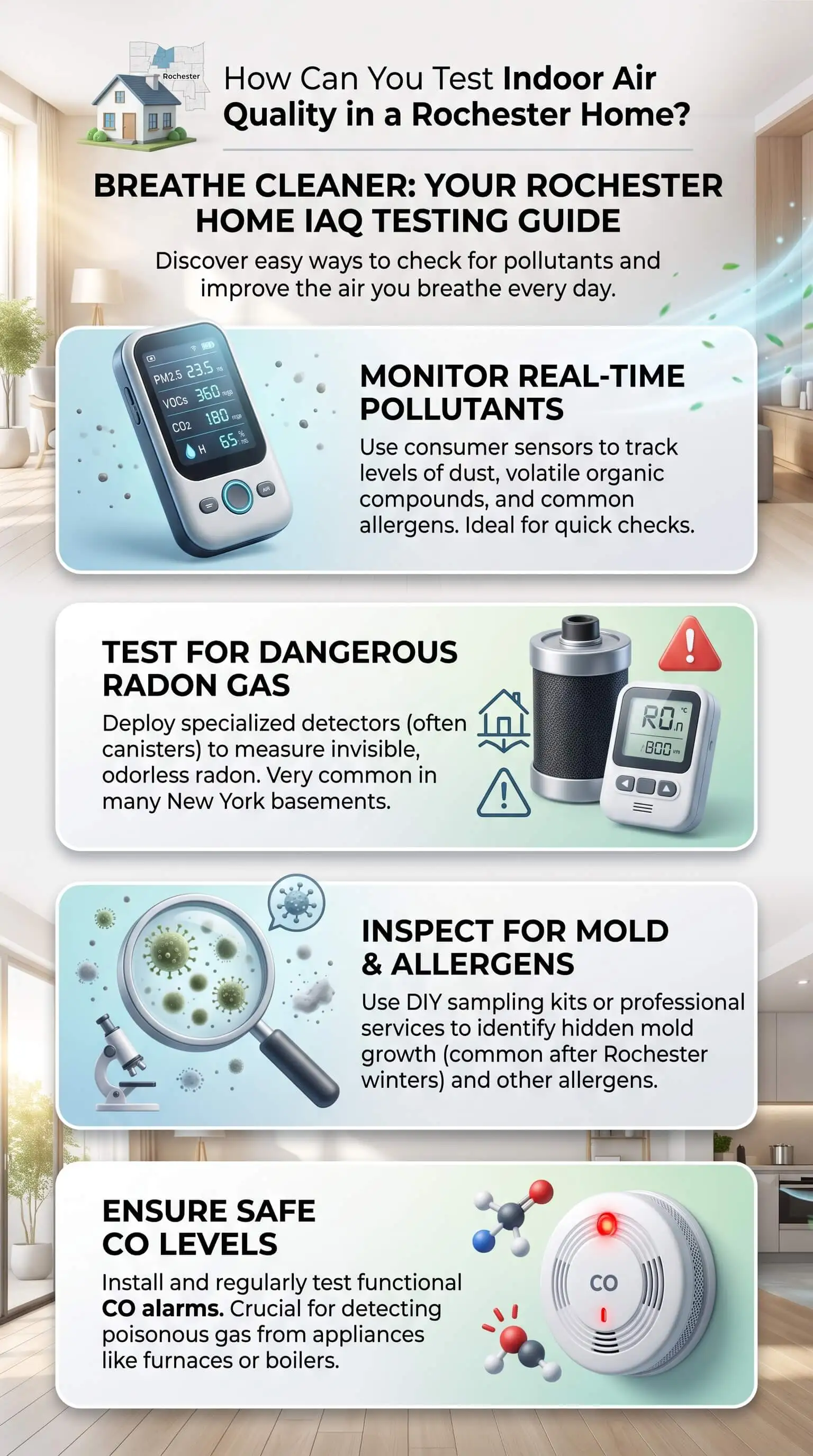
2. Carbon monoxide second. Alarms near every sleeping area, plus one detector with a digital readout so you catch low-level trends.
3. Moisture third. Use a hygrometer, target 30 to 50 percent humidity, skip the mold kits.
4. Particles last. Only meaningful when you compare against the outdoor index for those same hours.
Top Takeaways
• Test in order: radon, carbon monoxide, moisture, particles. Sequence protects your family better than equipment does.
• No consumer monitor catches radon or measures low-level carbon monoxide, the two hazards that matter most in this climate.
• The state radon kit costs $12.25 including lab analysis and return postage. Keep the house closed 24 hours before and throughout the test.
• Skip the mold kits. Buy a hygrometer, hold relative humidity between 30 and 50 percent, and go find the water source.
• An indoor particle reading means nothing without the outdoor number for those same hours.
• County environmental health investigates indoor air complaints, and eligible city residents can get a free in-home assessment.
What Makes This Climate Different
Long heating season, so combustion appliances run for months. Sealed house, so whatever gets inside stays inside and builds. And plenty of homes here sit over older basements cut into glacial soils that hold water and let soil gas move up.
Warm climates fight humidity and biological growth year-round. Our risks show up seasonally, and you can’t sense any of them. So I stopped starting with whatever was easiest to measure.
Radon First, Because You Can’t Sense It
Radon is a radioactive gas that works its way out of soil and rock into buildings through foundation cracks, slab joints, sump openings, and loose pipe penetrations. You can’t see it or smell it, and no consumer monitor on the shelf will catch it for you.
New York makes the test cheap. The state health department sells a short-term charcoal kit for $12.25, and that covers the device, the laboratory analysis, and the postage to send it back. You email them for an order form.
Protocol is where people go wrong, and I went wrong too. The state wants every exterior door and window closed for 24 hours before the test starts and straight through it, though you can still come and go. Halfway through my first attempt I cracked a basement window while running laundry and had to start over. Test during heating months instead. Keeping a Rochester house closed in January takes no effort.
Four picocuries per liter is the action threshold. At or above that, New York recommends fixing the home and says most can reach 2 or below. Retest every five years, every two with a mitigation system, and again within 30 days of installing one. State guidance puts a reduction system near $1,500 and credits up to 99 percent reduction.
Here’s a New York detail almost no national article carries. Testing firms and mitigators must report results to the Department of Health under Title 10 NYCRR 16.130. Raise that when you interview a contractor, and confirm your lab holds approval through the state Environmental Laboratory Approval Program. An HVAC system tune up can also help make sure the home’s heating and airflow systems are operating properly during the season. Before spending a dollar, look up what’s on record for your own town in the state radon dataset.
Then Carbon Monoxide, Before the Furnace Runs All Winter
Your carbon monoxide alarm exists to keep you alive, and it will do that job well. It sounds at concentrations high enough to count as an emergency, and it stays perfectly quiet below that line. So it won’t tell you the furnace has been leaking a little into the basement since October. It took me an embarrassingly long time to absorb that difference.
I run two things now. Alarms on every level and near every sleeping area, which is the baseline everyone should have. Then one detector with a digital readout that reports the highest concentration it recorded instead of waiting silently for an emergency. Watching that number creep tells you something you’d never learn otherwise.
What no homeowner can do is measure combustion performance. That takes a technician with an analyzer checking draft, flue integrity, and gas concentrations right at the appliance. If your readout moves, or your equipment is a decade old and nobody has ever looked at it, book that visit in early fall rather than during the first cold snap.
Skip the Mold Kit and Buy a Hygrometer
This section saves you the most money. Monroe County environmental health puts it plainly. There are no practical tests for biological contaminants for use by non-professionals. Those hardware store kits hand you a result that’s hard to read and rarely changes what you’d do anyway.
Measure humidity instead. A hygrometer costs about fifteen dollars. The county recommends holding relative humidity between 30 and 50 percent in living areas, and below 50 percent in attics and crawl spaces so condensation never settles into your building materials. I keep one in the basement and one on the main floor, because those two readings rarely agree.
That number tells you what to do, no laboratory involved. High readings point at exhaust fans that aren’t vented outdoors, a dryer venting inside, or standing water you haven’t found yet. The county wants you to dry water-damaged materials within 24 hours, vent kitchens and bathrooms outside, and clean visible growth off hard surfaces instead of naming the species. My basement runs about 62 percent every April until the dehumidifier goes on. That’s a maintenance problem, and no lab report was ever going to tell me so.
Particles Last, and Only Against an Outdoor Number
Now the consumer monitor earns its keep, with one condition attached. An indoor particulate reading means almost nothing alone. Take a reading of 18. On a clear day that number is alarming, and during a smoke event it’s excellent, which tells you it only means something once you set it against what the outdoor air was doing those same hours.
So before I read my own number, I check the live air quality index for Rochester NY and see where conditions actually sit. If the outdoor index reads 40 and my indoor number comes in higher, the source is inside my house and I go find it. If the outdoor index climbs past 100 and my indoor number sits at a fraction of that, my envelope and my filter are doing exactly what I need them to do.
Two local specifics matter here. Monroe County sits inside the state’s Eastern Lake Ontario advisory region, grouped with northern Cayuga, Jefferson, Oswego, and Wayne counties, so advisories cover that whole region rather than the city alone. The state also warns that hourly consumer app readings are snapshots rather than the averages the official index uses, which is why your app and the forecast won’t always agree. On advisory days I close up, run the system on recirculation, and use the highest efficiency filter my equipment accepts.
When to Stop Testing Yourself
Home testing has a ceiling. If symptoms track with being at home, if water damage keeps appearing and you can’t trace it, or if you suspect a chemical exposure, county environmental health will give you guidance and open an investigation where warranted. Their indoor air line is 585-753-5075. Income-eligible city residents should also look at the Healthy Neighborhood Program, which sends trained staff to walk your home at no cost.
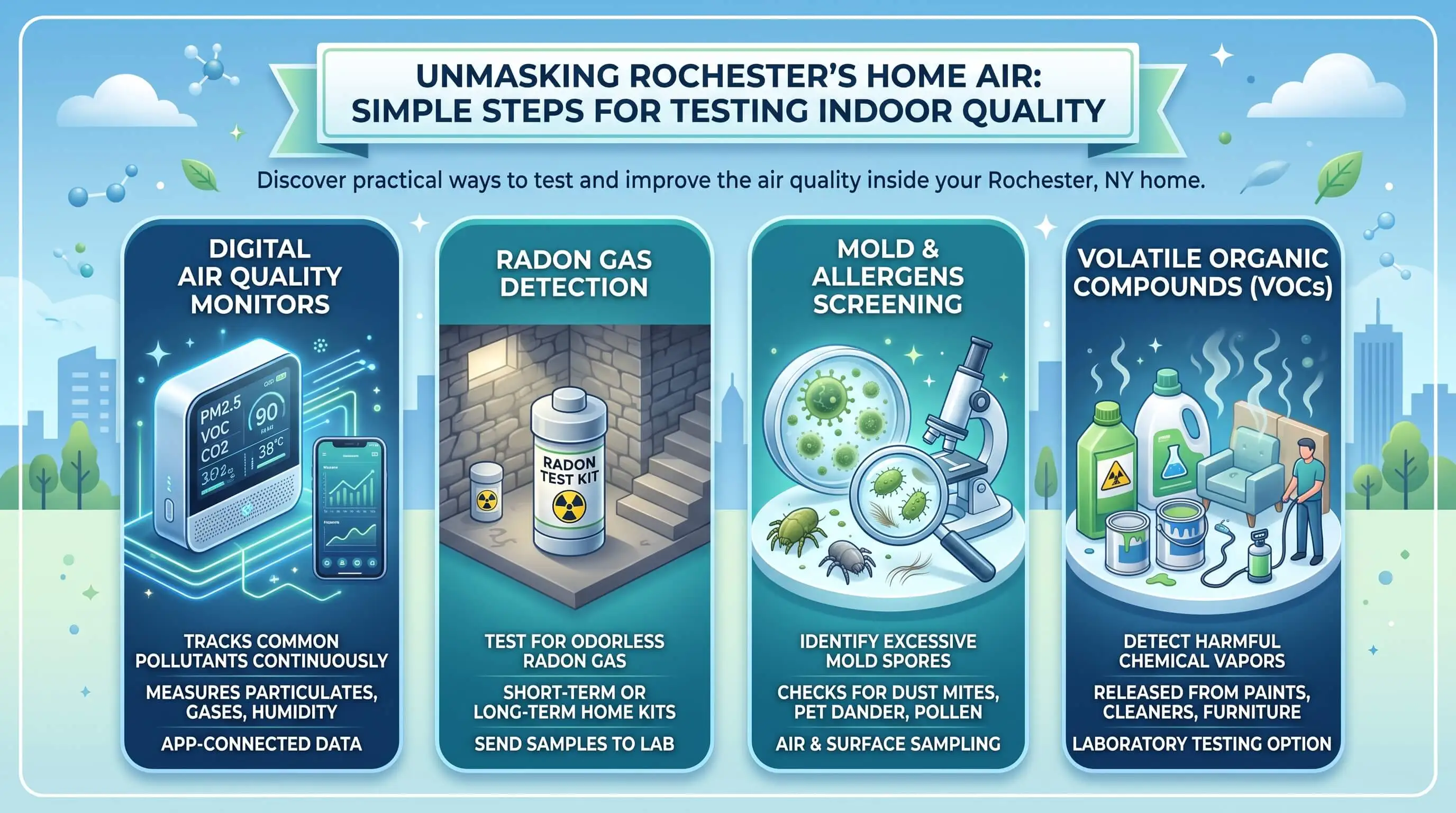
"Four winters of measuring my own house taught me one thing worth repeating. Buy the twelve-dollar test before you buy any device at all. I spent roughly $180 on a monitor that graphs particulates and volatile compounds beautifully, and it’s blind to both hazards that could put someone in my family in a hospital. The state radon kit cost less than lunch and told me what that monitor never could. Sequence first. Equipment second."
7 Essential Resources
1. New York State Department of Health, Radon. Kit pricing, ordering, protocol, action levels, and the state reporting rule.
2. Monroe County Environmental Health, Indoor Assessment. County guidance on indoor air complaints, humidity targets, and mold.
3. NYSDEC Air Quality Index Forecast and Current Observations. Forecasts and advisory regions, including Eastern Lake Ontario.
4. AirNow, New York. Federal index readings and the fire and smoke map for wildfire events.
5. EPA Map of Radon Zones. How county radon potential gets classified, and why every home still needs testing.
6. CPSC Carbon Monoxide Information Center. Alarm placement, appliance safety, and generator hazards.
7. Health Data NY, Radon Test Results by County. Recorded results for your own county going back to 1987.
New York and Monroe County resources give homeowners clear guidance on radon, mold, carbon monoxide, wildfire smoke, and local air-quality conditions, with indoor air quality testing services providing a more direct way to evaluate what is actually happening inside the home.
3 Statistics
1. Statewide, the basement screening estimate for New York homes above the 4 pCi/L action level is 18 percent, and the long-term living area estimate is 5 percent, drawn from more than 45,000 basement and 11,000 long-term measurements. NYSDOH Wadsworth Center
2. Unintentional carbon monoxide poisoning not linked to fires kills more than 400 Americans a year, sends more than 100,000 to an emergency department, and puts more than 14,000 in the hospital. Centers for Disease Control and Prevention
3. Nearly 5 percent of United States households used no space heating equipment in 2020, but the Northeast count came back statistically insignificant. Around here, running heat all winter is close to universal. U.S. Energy Information Administration
With radon and carbon monoxide posing year-round indoor risks and winter heating nearly universal across the Northeast, maintaining a recommended temperature for energy efficiency can help balance comfort, energy use, and safer indoor living conditions during the heating season.
Final Thoughts and Opinion
Here’s where I’ll take a position. The indoor air testing market has its priorities backwards. The devices marketed hardest measure whatever displays well on a screen, because particulates and volatile compounds make satisfying graphs. Radon and carbon monoxide never appear there, and those two carry the real consequences in a heating season this long.
I’m not arguing against consumer monitors. Mine earns its keep on smoke days and I’d buy it again. But buy it second. Twelve dollars and a sealed house in January tells you more about your family’s actual risk than any monitor on the market.
The mold instinct is the other thing I’d push back on, and I understand it completely. Visible growth feels like it ought to be named. But the county has this right. Find the water, fix the water, and the biology sorts itself out. MERV 13 pleated HVAC furnace air filters can then help capture smaller airborne particles circulating through the system once the moisture source has been addressed.
Frequently Asked Questions
How much does it cost to test indoor air quality in a Rochester home?
Less than most people expect. A state radon kit with lab analysis runs $12.25, a hygrometer about fifteen dollars, and a carbon monoxide detector with a digital readout usually under fifty. Top air filters are another practical place to start before spending more on monitoring equipment. The particle monitor is the expensive piece, and it belongs last.
When is the best time of year to test?
Winter, for both. The state requires your home stay sealed 24 hours before and throughout the radon test, far easier to pull off in January than June. Combustion risk also peaks when your heating equipment runs constantly.
Do consumer air quality monitors detect radon or carbon monoxide?
Almost never. A typical monitor reports fine particulates, volatile organic compounds, temperature, and humidity. Radon needs its own kit or a continuous monitor, and carbon monoxide needs its own alarm. Budget for them separately.
Are mold test kits worth buying?
Monroe County environmental health states there are no practical tests for biological contaminants for use by non-professionals. Spores are everywhere, so a positive result rarely tells you anything you can act on. Watch for water stains, damp surfaces, and musty smells, then get your humidity under control.
What humidity level should I hold in a Rochester basement?
County guidance recommends 30 to 50 percent relative humidity in living areas, and below 50 percent in attics and crawl spaces to keep condensation off building materials. Local basements drift above most springs, usually a dehumidifier and drainage question. Air ionizer installation can be considered separately when the goal is to address airborne particles rather than excess moisture.
Who do I contact if I think my home is making me sick?
Start with Monroe County environmental health at 585-753-5075. They give guidance on indoor air quality concerns, evaluate chemical exposure, and open investigations where required. Bring your measurements and whatever symptoms you’ve written down.
Next Steps
Pick one thing and do it this week. If nobody has ever tested your home for radon, that’s the one, and it costs about what a sandwich does. If someone has, check that every sleeping area has a working carbon monoxide alarm and find the manufacture date on each. They expire. Almost nobody checks.
Then set a hygrometer in the basement and leave it alone. Six months from now you’ll have something better than a single reading. You’ll have a record of how your own house behaves across a full Rochester heating season, including the conditions that may aggravate seasonal allergies, and you’ll be the one person in your household who actually knows.